Metal Powder Handling for 3D Printing: Why Must It Be Done in a Glovebox?

Metal Powder Handling for 3D Printing: Why Must It Be Done in a Glovebox?

3D printing (additive manufacturing) is transforming the way metal parts are produced. From aerospace superalloy blades to titanium alloy plates for medical implants, the application boundaries of metal 3D printing continue to expand. But before the “printing” action begins, there’s one step that is often overlooked yet directly determines the success or failure of the […]
Essential Reading for Lithium Battery R&D: How to Control Moisture via Glovebox to Improve Battery Cycle Life

In lithium battery R&D and production, moisture is one of the most insidious and destructive enemies. Trace amounts of moisture directly affect battery cycle life, safety, and consistency. As the core equipment for lithium battery material handling, coin cell assembly, and electrolyte filling, the glovebox’s moisture control capability directly determines the credibility of R&D data and […]

How Dual Column Purification Improves Glove Box Efficiency

For laboratories handling moisture and oxygen-sensitive materials such as lithium battery components, semiconductor chips, perovskite compounds, and specialty chemicals, a stable inert atmosphere is non-negotiable. The purification system defines the core performance of any recirculating glove box, directly influencing experimental consistency, sample yield, daily uptime, and long-term operational expenses. Many entry-level glove boxes rely on […]

What Is a Glove Box & How Does It Work

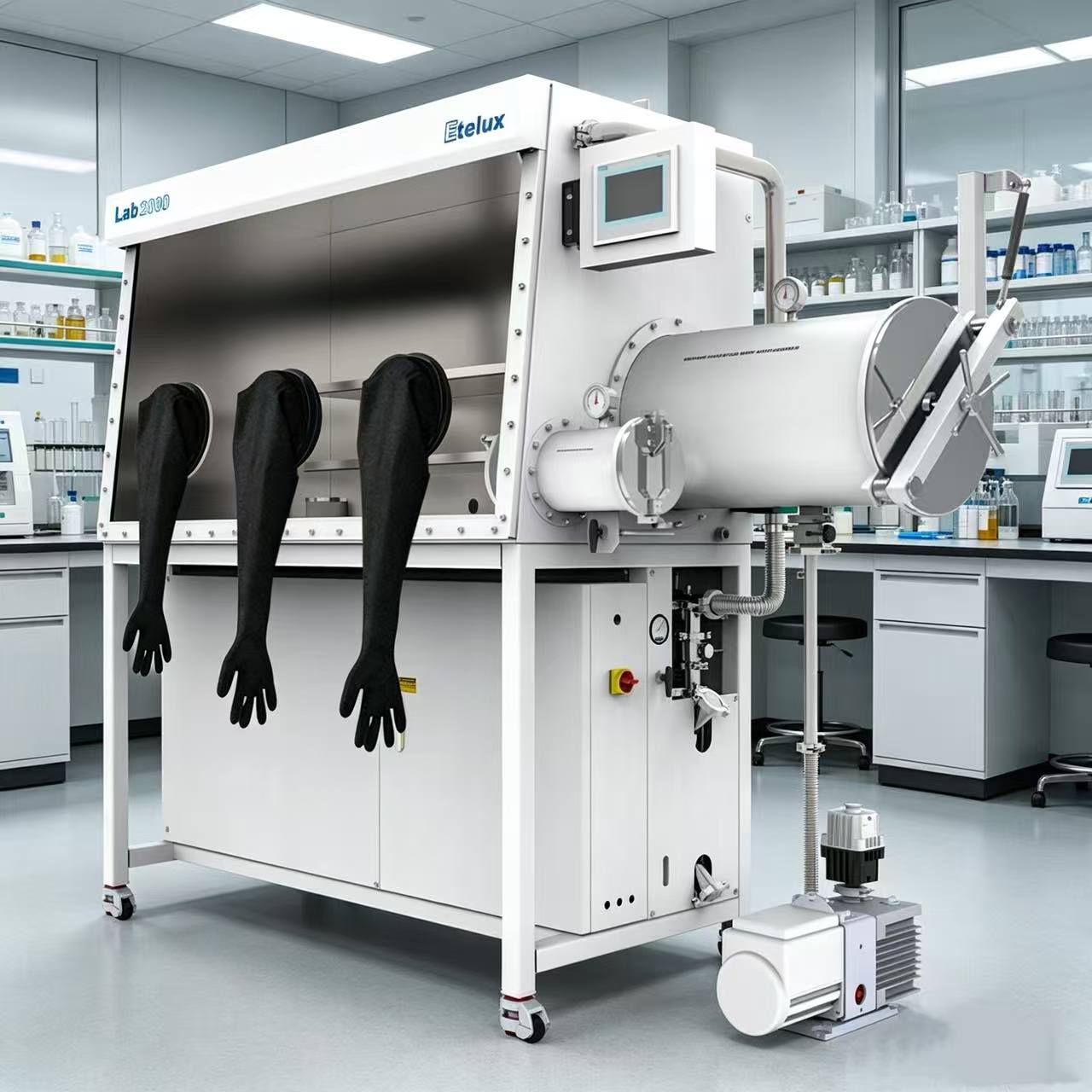
A glove box is a fully sealed, enclosed work station designed to separate internal operating space from outside ambient air. Operators handle sensitive materials via sealed gloves, creating a controlled, isolated environment for labs, new energy, semiconductor and chemical industries. It stabilizes inert gas, low humidity and vacuum conditions, effectively preventing material oxidation, moisture damage, […]

Single-side vs double-side glove box comparison

Difference Between Single-Side and Double-Side Glove Box

Glove boxes create sealed anhydrous and oxygen-free environments for labs and industrial use, mainly divided into single-side and double-side types. Choosing the right model impacts operation efficiency, space layout and experimental stability. Structural Difference A single-side glove box only has gloves and observation windows on one side, with a compact structure and simple internal piping. […]

Industrial Glove Boxes: The Water & Oxygen-Free Precision Operation Platform for R&D & Manufacturing

In cutting-edge fields such as semiconductors, new energy, and biopharmaceuticals, water, oxygen, and impurities are core pain points in experiments and production—even trace contamination can lead to material oxidation and performance failure. Industrial glove boxes create a controlled-atmosphere operation space with ultra-low water and oxygen levels below 1ppm through a fully sealed structure and inert […]

Essential Guide for Beginners: 5 Core Glove Box Selection Parameters

O2/H2O Level, Cleanliness, Material Struggling to choose a glove box for your lab or plant? A mismatched unit leads to failed experiments, low efficiency and material waste. The key is precision parameter-scenario matching, not blind pursuit of high-end specs. This guide breaks down 5 core selection parameters, plus a scenario matching table and pitfalls to […]

Glove Box Manufacturer

Standard and custom inert gas systems

Application Review

Share your materials and process requirements

Engineering Support

Configuration and application support

Project Quotation

Contact Etelux for a system quotation