
3D printing (additive manufacturing) is transforming the way metal parts are produced. From aerospace superalloy blades to titanium alloy plates for medical implants, the application boundaries of metal 3D printing continue to expand.
But before the “printing” action begins, there’s one step that is often overlooked yet directly determines the success or failure of the final part — metal powder handling.
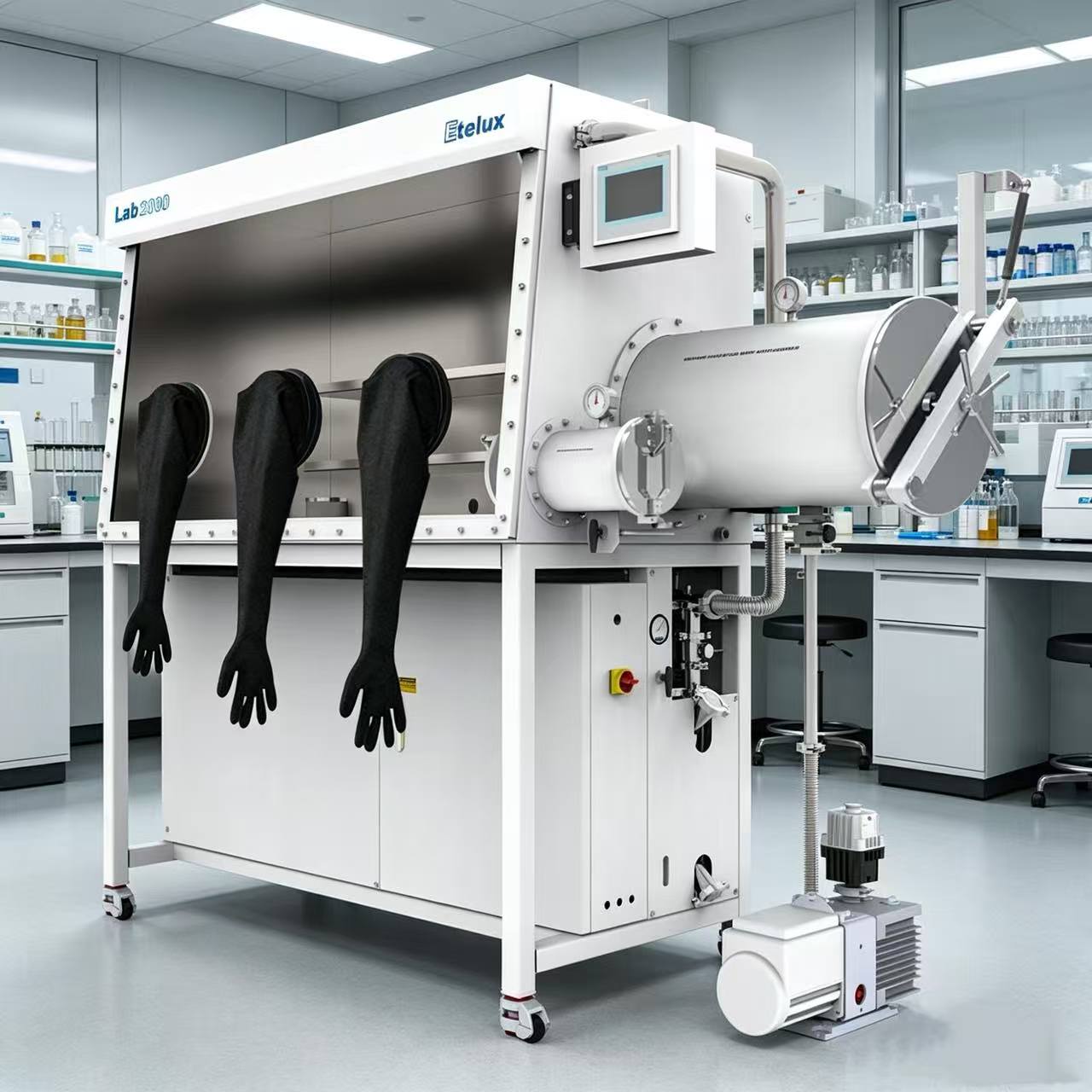
Why are more and more metal 3D printing manufacturers and powder suppliers choosing to complete powder sieving, mixing, dispensing, and recycling inside a glovebox? This article provides the answers.
I. The “Enemies” of Metal Powder: Oxygen and Moisture
The vast majority of metal powders used in 3D printing (such as titanium alloys, aluminum alloys, nickel-based superalloys, stainless steels, etc.) are extremely sensitive to oxygen and moisture.
1. Oxidation: Powder “Spoilage”
When metal powder is exposed to air, an oxide layer quickly forms on the particle surface. This oxide layer creates three problems:
| Problem | Consequence |
|---|---|
| Reduced flowability | Oxide layer increases surface roughness, uneven powder spreading affects print layer uniformity |
| Increased melting point | Oxides like alumina and titania have much higher melting points than the base metal, leading to incomplete melting |
| Degraded part performance | Oxide inclusions become crack initiation sites, reducing fatigue life and ductility |
A real example: Titanium alloy (Ti6Al4V) powder exposed to air for 24 hours can see oxygen content rise from 0.12% to over 0.25% — already exceeding the requirements for most aerospace-grade parts.
2. Moisture Absorption: An Even More Hidden Threat
Moisture adsorbed on powder particle surfaces will, during printing:
- Decompose at high temperatures to produce hydrogen gas, causing porosity
- React with metals to form oxides while releasing hydrogen
- Affect powder spreading behavior on the powder bed
In short: Oxidation and moisture absorption can make parts printed from the same batch of powder “pass today, fail tomorrow.”
II. How Does a Glovebox Solve These Problems?
A glovebox’s core function is to create a sealed inert gas environment, typically using high-purity argon or nitrogen, maintaining extremely low moisture and oxygen levels.
Three Layers of Protection from the Glovebox
| Protection | How It’s Achieved | Typical Specification |
|---|---|---|
| Oxygen isolation | Sealed chamber + inert gas purging/recirculation | O₂ < 10 ppm (or even < 1 ppm) |
| Moisture removal | Molecular sieves in purification column | H₂O < 10 ppm |
| Dust prevention | Sealed operation + antechamber transfer | Prevents environmental powder contamination |
In this environment, powder from can opening, sieving, mixing, and loading into the printer’s hopper never contacts air.
III. Which Operations Must Be Performed in a Glovebox?
Here are four critical steps in metal 3D printing powder handling that are strongly recommended to be performed inside a glovebox:
1. Powder Can Opening and Dispensing
Raw powder is shipped under inert gas protection. Once opened, if not protected by inert gas, oxidation begins immediately.
Glovebox operation: The entire can opening and dispensing process is performed under argon, ensuring seamless transition from the manufacturer’s protective atmosphere to the printer.
2. Powder Sieving
Recycled powder may contain spatter particles, unmelted particles, or agglomerates that need to be removed by sieving.
Glovebox operation: A vibratory sieve is placed inside the glovebox, and the sieving process is completed under inert atmosphere, preventing recycled powder from degrading due to air exposure.
3. Powder Mixing
Certain applications require mixing powders of different particle size distributions or compositions in specific ratios.
Glovebox operation: V-blenders or three-dimensional mixers run inside the glovebox, and the mixed powder can be used directly without additional protection.
4. Powder Recycling and Reuse
Metal powder utilization rates are typically only 30%-60%, with large amounts of powder needing recovery after printing.
Glovebox operation: Powder is collected from the printer’s overflow hopper or recovery container, then sieved, replenished with new powder, and repackaged — all inside the glovebox. This is the most easily overlooked yet most critical step, because recycled powder has the highest chance of having been exposed to air.
IV. What Happens Without a Glovebox? Real Risk Comparison
| Risk Scenario | Potential Consequence | Severity |
|---|---|---|
| Powder exposed to air for 30 minutes after opening | Surface oxidation, reduced flowability | Medium |
| Recycled powder sieved in open air | Severe oxidation + moisture absorption, entire batch scrapped | High |
| Mixed powder contaminated with dust | Inclusion defects in printed parts | High |
| Reactive powder (e.g., aluminum, titanium) exposed to moisture | Exothermic reaction, even risk of fire/explosion | Extremely High |
Special note: Reactive metal powders like aluminum and titanium can undergo exothermic reactions in humid air, potentially causing fires or dust explosions in severe cases. The glovebox is not just a quality assurance tool — it’s also a safety protection measure.
V. What Special Configurations Does a Glovebox Need for Metal Powder Handling?
Compared to gloveboxes for laboratory chemical synthesis, metal powder handling requires some special features:
| Configuration | Purpose | Recommended? |
|---|---|---|
| Large chamber size | Accommodate sieving machines, mixers, etc. | ✅ Essential |
| Reinforced load-bearing stand | Support continuous vibration from sieve shakers | ✅ Recommended |
| Anti-static design | Prevent powder from sticking due to static charge or electrostatic discharge | ✅ Recommended |
| High-efficiency filtration system | Remove fine suspended powder inside chamber | ✅ Recommended |
| Double-sided operation | Facilitate multi-person work or large equipment operation | ⭐ On demand |
| Antechamber heating function | Dry powder before introducing to chamber | ⭐ On demand |
A practical tip: If handling titanium alloys or aluminum powder, consider adding an explosion-proof pressure relief port — even though the glovebox contains inert atmosphere, extra protection is always wise for any electrical fault or accident.
VI. Typical Workflow: From Powder to Print
Here’s a complete standard “powder handling inside glovebox” process for reference:
text
Step 1: Antechamber transfer
- Place unopened powder can into antechamber
- Vacuum-purge with argon, 3 cycles

Step 2: Can opening and inspection
- Open powder can inside glovebox
- Visually inspect powder condition (clumping, color change, etc.)

Step 3: Sieving
- Pour powder into vibratory sieve
- Collect sieved powder into containers

Step 4: Mixing (if needed)
- Add different batches or particle sizes to mixer
- Mix for set duration

Step 5: Dispensing and transfer out
- Load into printer-specific hopper or storage container
- Transfer out via antechamber or rapid transfer port

Step 6: Printing
- Install hopper onto printer
- Powder never contacted air throughout process
VII. Summary: Glovebox Isn’t “Optional” — It’s “Essential”
In metal 3D printing, powder is the “genetic code” of the product.
If the “genes” are already oxidized, moisture-exposed, or contaminated before printing even begins, then no matter how advanced the printer or how well-tuned the parameters, you cannot produce合格的 parts.
For the following applications, a glovebox is nearly mandatory:
- Aerospace components (extremely high fatigue life requirements)
- Medical implants (no oxide inclusion risk tolerated)
- Molds and tool steels (strict density and hardness standards)
- Reactive materials (titanium, aluminum, magnesium, and their alloys)
For R&D and small-scale production, a glovebox is an investment with exceptionally high ROI — it protects not just the powder, but the yield rate of every part and the credibility of every experiment’s data.
Does your metal 3D printing powder handling process already include inert gas protection? Need glovebox selection advice? [Contact us] or leave a comment below.
Appendix: Key Takeaways Quick Reference
| Key Point | Summary |
|---|---|
| Main risks to metal powder | Oxidation, moisture absorption, dust contamination |
| Glovebox core function | Provide low-oxygen, low-humidity inert gas environment |
| Operations requiring glovebox | Can opening/dispensing, sieving, mixing, recycling |
| Most severe risk without glovebox | Reactive powder fire/explosion, entire batch scrap |
| Special configuration needs | Large size, anti-static, filtration system |
| Target industries | Aerospace, medical, molds & tooling, reactive materials |