
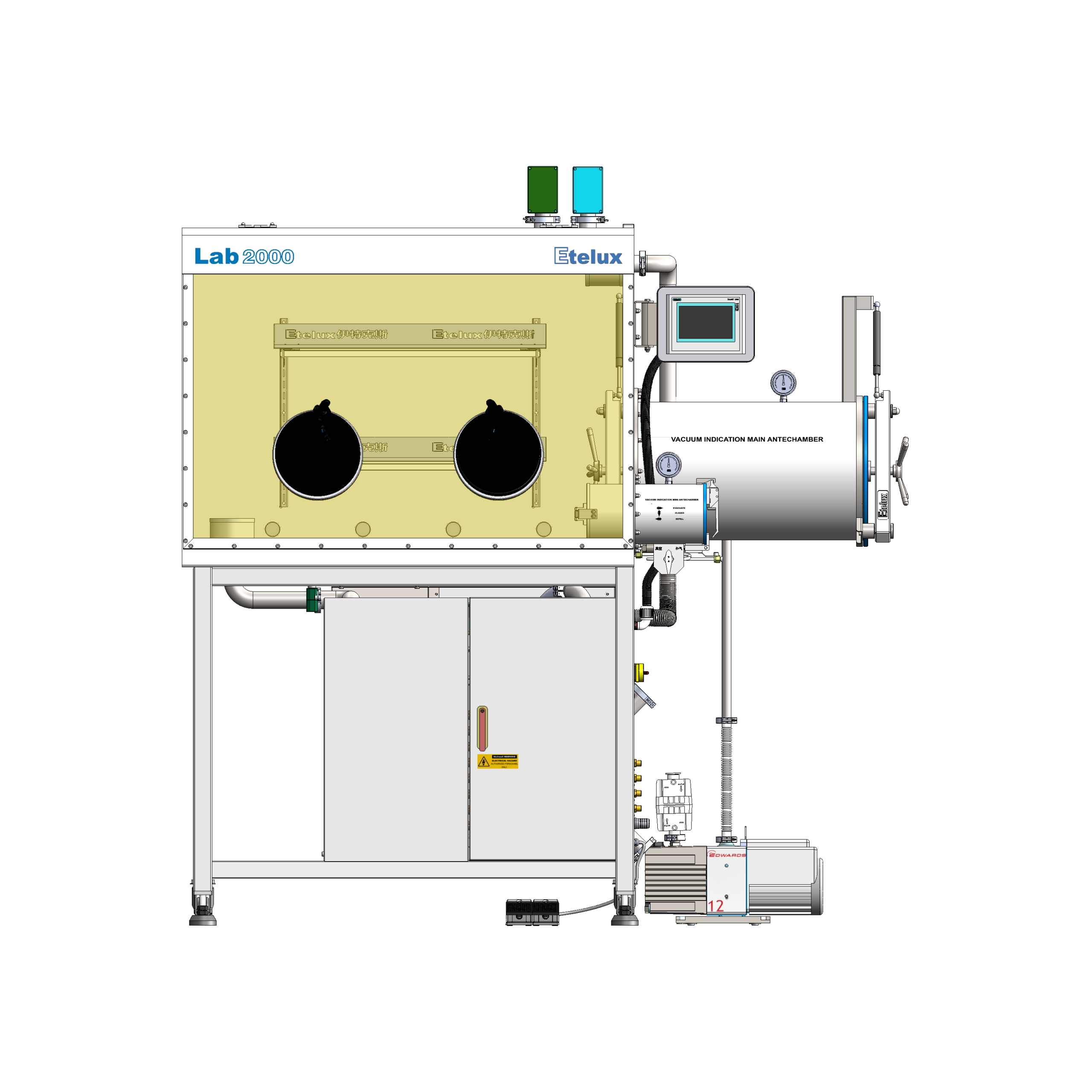
In the use of gloveboxes, gas purity is the core factor determining experimental success. Whether in lithium battery R&D, perovskite solar cell fabrication, or OLED material processing, accurately understanding and measuring the water and oxygen levels inside the glovebox is essential. This article systematically reviews the measurement methods for glovebox gas purity, key parameters, and common unit conversion issues, helping you better control your experimental environment.
1. Why Does Gas Purity Matter?
The core function of a glovebox is to provide a highly clean, high-purity inert gas atmosphere that protects moisture- and oxygen-sensitive materials and processes. If the gas purity inside the chamber falls below standards, it may lead to material oxidation, failure, or even safety incidents. Therefore, continuous monitoring of oxygen, moisture, and nitrogen levels is fundamental to ensuring experimental reliability.
2. Key Measurement Parameters and Standards
Glovebox gas purity monitoring primarily focuses on the following three critical parameters:
2.1 Oxygen Content
Oxygen is the enemy of most sensitive materials. Requirements for oxygen levels vary significantly depending on the application:
- Highest requirement (<1 ppm): Applicable to lithium metal, perovskite solar cells, OLED materials, quantum dots, etc. These materials may degrade within seconds of exposure to air.
- High requirement (<10 ppm): Applicable to high-nickel ternary materials, solid-state electrolytes, sensitive catalysts, etc.
- Moderate requirement (<100 ppm): Applicable to conventional lithium battery cathode/anode materials, organic synthesis, metal powder handling, etc.
- Basic requirement (<1000 ppm): Applicable to general moisture and oxidation protection, pharmaceutical dispensing, teaching demonstrations, etc.
2.2 Moisture Content
Moisture content is listed alongside oxygen as a core glovebox indicator. For stringent environments, moisture levels also need to be controlled below 1 ppm. In certain high-precision applications, the dew point corresponding to the moisture content must reach -70°C or even lower.
2.3 Nitrogen Content
For gloveboxes using argon or helium as the working gas, monitoring trace nitrogen is an effective method for leak detection, since air contains approximately 78% nitrogen. If an increase in nitrogen concentration is detected, it indicates possible leakage in the chamber.
3. Common Measurement Methods and Instruments
Accurate data acquisition requires professional measuring instruments. The following are several common detection devices:
| Parameter | Common Instrument | Key Features |
|---|---|---|
| Oxygen Concentration | Oxygen Analyzer | Fluorescent trace oxygen transmitters offer high selectivity for oxygen and fast response times. |
| Moisture Content | Dew Point Meter, Trace Moisture Transmitter | High-precision dew point meters measure from -100°C to +20°C with high repeatability. |
| Comprehensive Gas Purity | Mass Spectrometer, Gas Chromatograph | Simultaneously quantify multiple gas components, suitable for extremely high-purity environments. |
In addition, the leak rate is a critical indicator of glovebox performance. Industry standards typically require a leak rate ≤0.05 vol%/h, while high-performance equipment can achieve ≤0.001 vol%/h.
4. Key Unit Conversions: ppm and Dew Point
In practice, it is often necessary to convert between volumetric concentration (ppm) and dew point, especially for moisture content representation.
- ppm (parts per million): Represents the volume fraction of a component in a gas. 1 ppm = 0.0001%. For example, a water/oxygen specification of <1 ppm means that in 1,000,000 parts by volume of inert gas, the volumes of water and oxygen each do not exceed 1 part.
- Dew Point: The temperature at which water vapor in the gas begins to condense into liquid water. The lower the dew point, the drier the gas.
Common Conversion Reference:
- Moisture content < 1 ppm: Corresponds to a dew point of approximately -76°C to -78°C.
- Moisture content < 10 ppm: Corresponds to a dew point of approximately -60°C.
A Practical Conversion Logic:
Calculations can also be made based on leak rate standards. For example, a 1 m³ glovebox with a leak rate of 0.05 vol%/h means that 0.5 L of air leaks in per hour. Since oxygen accounts for about 21% of air, the oxygen introduced per hour due to leakage is 0.105 L, which translates to approximately 105 ppm. This calculation helps understand the practical impact of leak rate on purity.
5. Common Misconceptions in Measurement
In the measurement and maintenance of glovebox purity, several issues are often overlooked:
- Focusing only on “can achieve” rather than “can maintain”: Some equipment shows excellent readings right after startup, but the data rebounds quickly after a few chamber door openings. What truly matters is the system’s ability to stably maintain low water and oxygen levels over the long term, which depends on chamber leak rate and purification system efficiency.
- Neglecting solvent interference: If experiments involve volatile solvents such as DMF or DMSO, solvent vapors can interfere with sensor readings and shorten purifier column life. In such cases, an additional solvent adsorption system is required.
- Incorrect sensor placement: The installation position of sensors directly affects the representativeness of measurements. Trace oxygen sensors are typically installed directly inside the chamber for real-time leak monitoring, while supply gas purity checks can be performed at the inlet.
Conclusion
Accurately measuring and understanding glovebox gas purity is a prerequisite for successful experiments. Selecting the appropriate analytical instruments, clarifying purity standards for different applications, and mastering the conversion relationships between key units such as ppm and dew point will help you operate and maintain your glovebox equipment more effectively.
If you have any further questions about glovebox selection or gas purity measurement, please feel free to contact us.
Related Reading
New Trends in the Inert Atmosphere Glove Box Industry in 2026: From Standalone Equipment to Intelligent System Solutions
Safe Emission of Glovebox Waste Gas: The Last Line of Defense for Laboratory Safety