
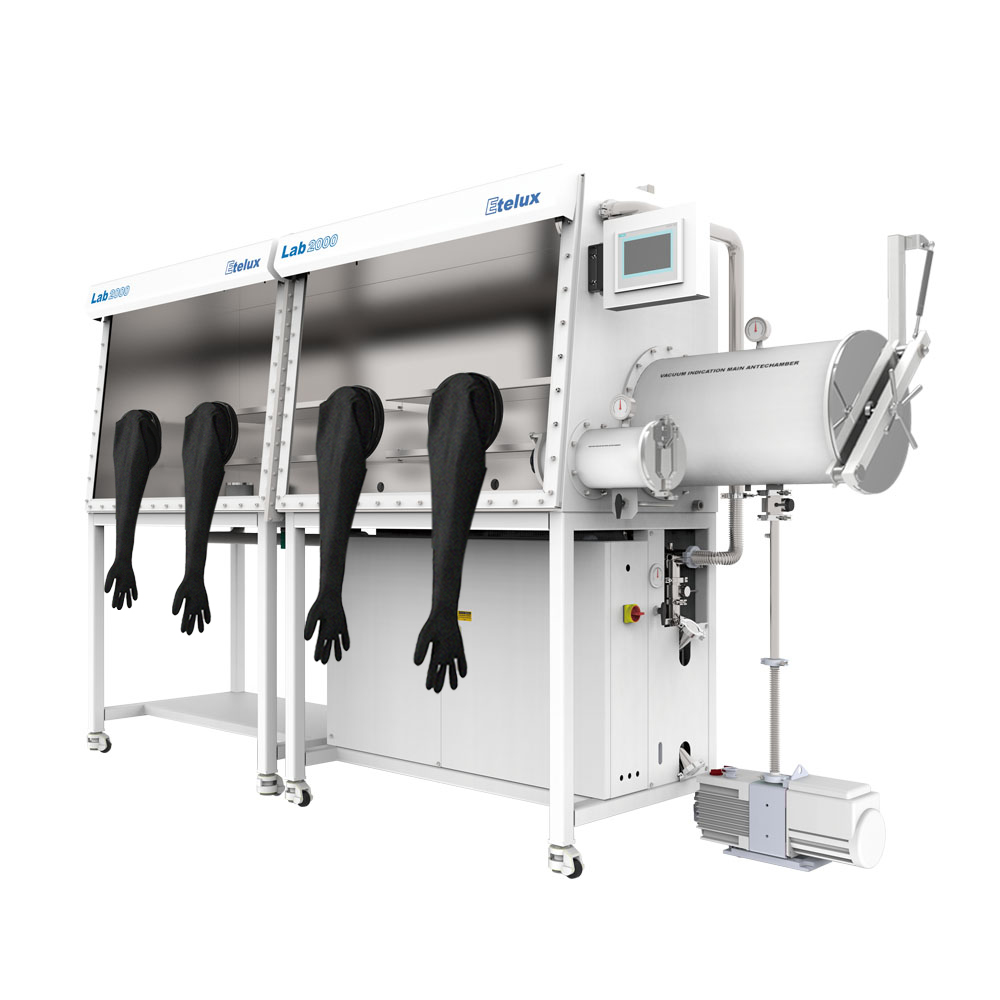
Water and oxygen levels in a glovebox are probably the most frequently asked about and most easily misunderstood parameters during procurement. Many users assume that whatever the manufacturer’s spec sheet says—for instance, “<1 ppm”—means it’s qualified. But here’s the reality: “being able to reach” and “being able to maintain stably over the long term” are two entirely different things, and different experiments have completely different requirements for water and oxygen levels. This post will help you thoroughly understand what truly counts as “qualified.”
1. Understanding What Water and Oxygen Levels Actually Mean
Water and oxygen levels refer to the concentrations of H₂O and O₂ inside the glovebox, measured in ppm (parts per million), where 1 ppm equals 0.0001%. Lower levels indicate a purer environment, but the demands on the chamber’s sealing integrity, purification system, and routine maintenance increase exponentially.
A critical point to note: there’s a difference between “momentarily achievable” and “long-term stable maintenance.” Some equipment can indeed reach <1 ppm right after startup, but after opening the door to change samples, the levels quickly bounce back to tens of ppm. What truly determines qualification is the ability to maintain stability over time—which depends on the chamber’s leak rate and the efficiency of the purification system.
2. The “Qualification Line” Varies Completely by Application
The standard for what’s considered “qualified” in terms of water and oxygen levels depends first and foremost on how sensitive your experimental materials are. Here’s a breakdown by typical tiers:
<1 ppm, the highest requirement — lithium metal, lithium metal anodes, perovskite solar cells, OLED materials, quantum dots, superconducting materials. These materials degrade within tens of seconds of air exposure and require high-end purification gloveboxes, with dual-column or automatic regeneration systems as standard equipment.
<10 ppm, high requirement — high-nickel ternary materials, silicon anodes, solid-state electrolytes, sensitive catalysts (such as Ziegler-Natta catalysts), MOF materials. Suitable for most cutting-edge research.
<100 ppm, medium requirement — conventional lithium battery cathode/anode materials (lithium iron phosphate, graphite), organic synthesis, metal powder handling, semiconductor packaging. This level meets the vast majority of research and production needs.
<1000 ppm or higher, basic requirement — general moisture and oxidation protection, pharmaceutical dispensing, electronic component storage, teaching demonstrations. These scenarios can use acrylic gloveboxes with desiccants or simple stainless steel enclosures without purification systems.
So, there is no one-size-fits-all standard for “qualified”—it depends entirely on your experimental needs. Configuring a <1 ppm system for teaching demonstrations is a waste of budget, while using a <100 ppm system for perovskite experiments will simply fail to produce results.
3. Industry Reference Values: The Mainstream Standard for Research Institutions
Based on actual university procurement cases over the past two years, the mainstream requirement for research-grade gloveboxes is <1 ppm for both water and oxygen, with some experiments requiring extreme environments even pushing for <0.1 ppm.
Here are a few reference examples:
Shandong Jiaotong University’s glovebox technical specifications require water/oxygen ≤0.1 ppm, with purification media configured as 5 kg of copper catalyst and 5 kg of molecular sieve.
Ningbo University’s Braun glovebox requires water/oxygen <0.1 ppm and a leak rate <0.002 vol%/h, tested under ISO 10648-2 standards.
MBRAUN defines its industry-standard specification as water/oxygen <1 ppm, with oxygen analyzers specifically designed for precise monitoring at concentrations below 1 ppm.
The economical dual-station glovebox from Etelux is rated at water <50 ppm and oxygen <50 ppm, suitable for less demanding applications.
Additionally, standard gloveboxes in general typically require water content ≤1 ppm, oxygen content ≤1 ppm, and a leak rate ≤0.05 vol%/h.
4. A More Critical Parameter Than Water/Oxygen Readings: Leak Rate
Many users focus solely on water and oxygen numbers while overlooking the fundamental factor that determines whether those numbers can be maintained—the leak rate. Industry standards typically require a leak rate ≤0.05 vol%/h, but high-quality equipment can achieve much lower:
Ningbo University’s glovebox has a leak rate <0.002 vol%/h under ISO 10648-2 standards.
Etelux equipment achieves a leak rate ≤0.001 vol%/h, with some models reaching 0.0008 vol%/h.
A lower leak rate means less external air infiltration, lower gas consumption, and longer regeneration cycles for purification columns—directly impacting long-term operating costs. Always request actual leak rate test reports from manufacturers during the selection process, rather than just looking at the water/oxygen specs on the datasheet.
5. How to Determine Which Level Your Experiment Requires
If you’re still uncertain, evaluate from these dimensions:
Assess material sensitivity — check the literature or ask colleagues: how long does your material take to degrade upon air exposure? If it fails within minutes, go for <1 ppm; if degradation takes hours, <100 ppm may suffice.
Examine process requirements — for the same material, different stages—synthesis, assembly, and testing—may have different water/oxygen requirements. For example, perovskite precursor preparation has relatively lower requirements, but film deposition and encapsulation demand much stricter conditions. Choose based on the most demanding stage.
Consider operational frequency — if you open the chamber frequently every day, water/oxygen levels will fluctuate, requiring stronger stabilization capability. For high-frequency operations, it’s advisable to choose one tier stricter than the theoretical requirement.
Plan for future expansion — if you may work with more sensitive materials down the road, leave some margin in your selection to avoid outgrowing your equipment.
In summary: the “qualified” standard for glovebox water and oxygen levels depends on your experimental needs, not on whatever number the manufacturer prints on the spec sheet. First, clarify your material system, process steps, and operational frequency, then match them against the tier breakdown above—you’ll largely avoid making the wrong choice.
If you’re still unsure after reading, feel free to share what materials you’re working with, and I can help determine which level is right for you.