
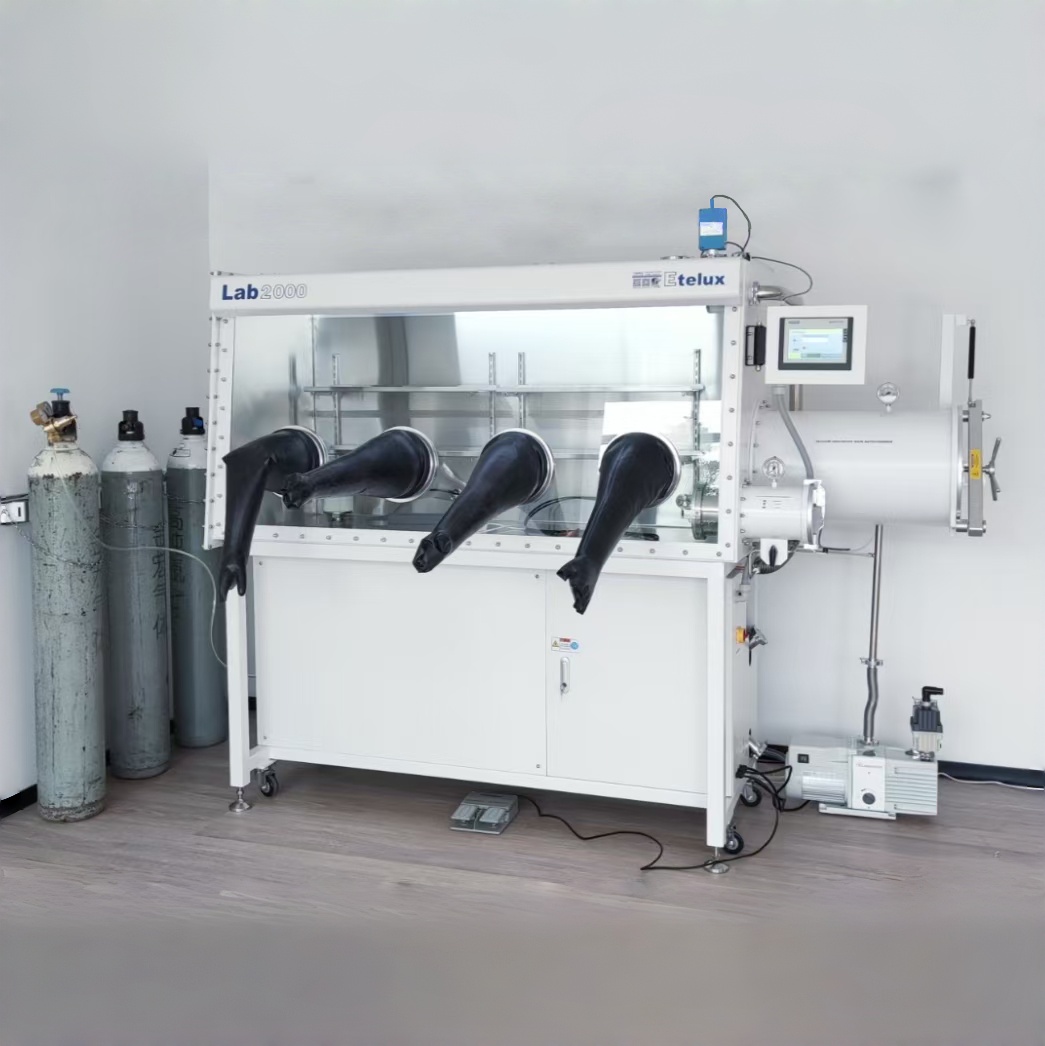
Industry Background and Challenges
In the production and handling of Active Pharmaceutical Ingredients (APIs), moisture protection and isolation are two core concerns. Many APIs are hygroscopic and will absorb moisture when exposed to air, leading to caking, degradation, and even loss of potency. At the same time, Highly Potent Active Pharmaceutical Ingredients (HPAPIs) and cytotoxic compounds pose health risks to operators and must be handled in contained environments during weighing, dispensing, milling, and other operations.
The traditional approach uses laminar flow hoods (Class 100), but this method does not achieve true isolation—it neither guarantees product protection from external contamination nor ensures operator protection from drug exposure. Containment technology originated from glove boxes used during World War II and has evolved over decades to become a standard solution in the pharmaceutical industry.
The Core Value of Glove Boxes in API Moisture Protection
1. Precise Humidity Control
The key to API moisture protection is creating a consistently stable low-humidity environment. Glove boxes equipped with purification systems can maintain moisture and oxygen levels below 1 ppm, which is critical for highly hygroscopic APIs.
Glove boxes achieve precise humidity control by circulating inert gas (high-purity argon or nitrogen) through purification columns that adsorb water molecules. Unlike conventional drying ovens, glove boxes can maintain low-humidity conditions continuously during operations, without compromising the protected state when the door is opened for material transfer.
2. Dual Protection for Operators and Materials
The sealed chamber of a glove box physically isolates operators from materials. For HPAPIs with cytotoxic, teratogenic, or highly sensitizing properties, this is an absolute requirement. Operators work through gloves fixed to the chamber, without direct contact with materials at any time—ensuring both operator safety and preventing human-borne product contamination.
Negative-pressure glove boxes (often referred to as isolators) provide an additional safeguard: even in the event of minor leakage, airflow is directed inward, preventing material particles from escaping to the external environment.
3. Static Control for Powder Handling
APIs are frequently handled in powder form, which tends to generate static electricity during weighing and transfer. Static causes powder to scatter, adhere to surfaces, and result in inaccurate measurements. Professional glove boxes can integrate anti-static ion blowers to neutralize static charges within the working chamber, improving powder handling precision and safety.
Typical Application Scenarios and Process Steps
Scenario 1: Weighing and Dispensing of Sterile APIs
In sterile API manufacturing, weighing and dispensing are two critical steps. Conventional laminar flow hoods cannot achieve true containment, nor do they support CIP (Clean-in-Place) and SIP (Sterilization-in-Place).
Specialized glove box isolators address these requirements through:
- Overhead air handling systems with both supply and exhaust HEPA filters to maintain Grade A cleanliness inside
- Sterile transfer ports using RTP (Rapid Transfer Ports) for sterile material transfer without breaking containment
- Aseptic docking valves allowing dispensing containers to be sterile-docked to the bottom of the isolator for closed transfer
- Drainage systems supporting CIP wastewater discharge
Scenario 2: Milling and Micronization of HPAPIs
Micronization is a common technique to improve the bioavailability of poorly soluble drugs, but the process generates significant dust and high exposure risk. For these applications, glove boxes are designed as integrated systems that can house various milling equipment such as jet mills and hammer mills.
Key design features:
- The mill is placed inside the glove box; operators perform feeding, discharging, and disassembly through the gloves
- Double continuous liner bag systems are used for material transfer to achieve extremely low exposure levels (10 ng/m³ range)
- The milling chamber is purged with nitrogen to prevent dust explosion hazards
Scenario 3: Stability Testing and Sample Preparation
During the API development phase, samples need to be dispensed and sealed under controlled atmospheres for long-term stability studies. Glove boxes provide an anhydrous and oxygen-free environment for this process, ensuring samples are not affected by ambient conditions during preparation.
Product Selection Guidelines
Material Selection
| Material | Advantages | Best For |
|---|---|---|
| Stainless Steel | Excellent sealing, corrosion resistance, vacuum capability, easy to clean and sanitize | HPAPI handling, aseptic operations, solvent contact |
| Acrylic | Transparent, cost-effective, easy observation | Teaching demonstrations, basic powder handling, limited budgets |
For applications involving sterile APIs or HPAPIs, stainless steel is the necessary choice, with designs that meet GMP requirements for smooth surfaces and easy cleaning.
Key System Configurations
Purification System:
- Moisture and oxygen levels must reach <1 ppm
- Purification columns should feature automatic regeneration using hydrogen-containing mixed gas or inert gas
- Circulating fan airflow rate should be no less than 100 m³/hour
Control System:
- PLC touch panel for centralized control with real-time display of moisture/oxygen levels and pressure trends
- Auto-purge function that activates when H₂O/O₂ levels exceed thresholds
- Remote monitoring and maintenance alerts
Filtration System:
- HEPA or ULPA filters (H14 grade) for supply air and recirculating gas
- Double HEPA filtration recommended for highly active materials
Transfer System:
- RTP ports ideal for sterile or HPAPI material transfer
- Continuous liner bag systems for high-potency powder discharge and packaging
Validation and Compliance
When glove boxes are used in pharmaceutical manufacturing, they must undergo validation.
Leak testing is the foundation—verifying that the chamber seal meets specifications. However, a more stringent validation method is SMEPAC testing (Standardized Measurement of Equipment Particulate Airborne Concentration). This test simulates actual operating conditions, with sampling points placed at the operator’s breathing zone and surrounding environment to detect airborne particle concentrations, verifying that occupational exposure levels meet required standards.
For sterile API processing, sterilization efficacy must also be validated—using VHP (Vaporized Hydrogen Peroxide) to sterilize the isolator interior, achieving a 6-log kill rate—and comply with USP 1208 requirements for isolator system validation.
Conclusion
The application of glove boxes in pharmaceutical API moisture protection has evolved from a “nice-to-have tool” to an “essential compliance equipment.” Whether driven by quality considerations or safety and regulatory compliance, equipping API handling operations with professional glove box isolator solutions is a forward-looking and pragmatic choice.