
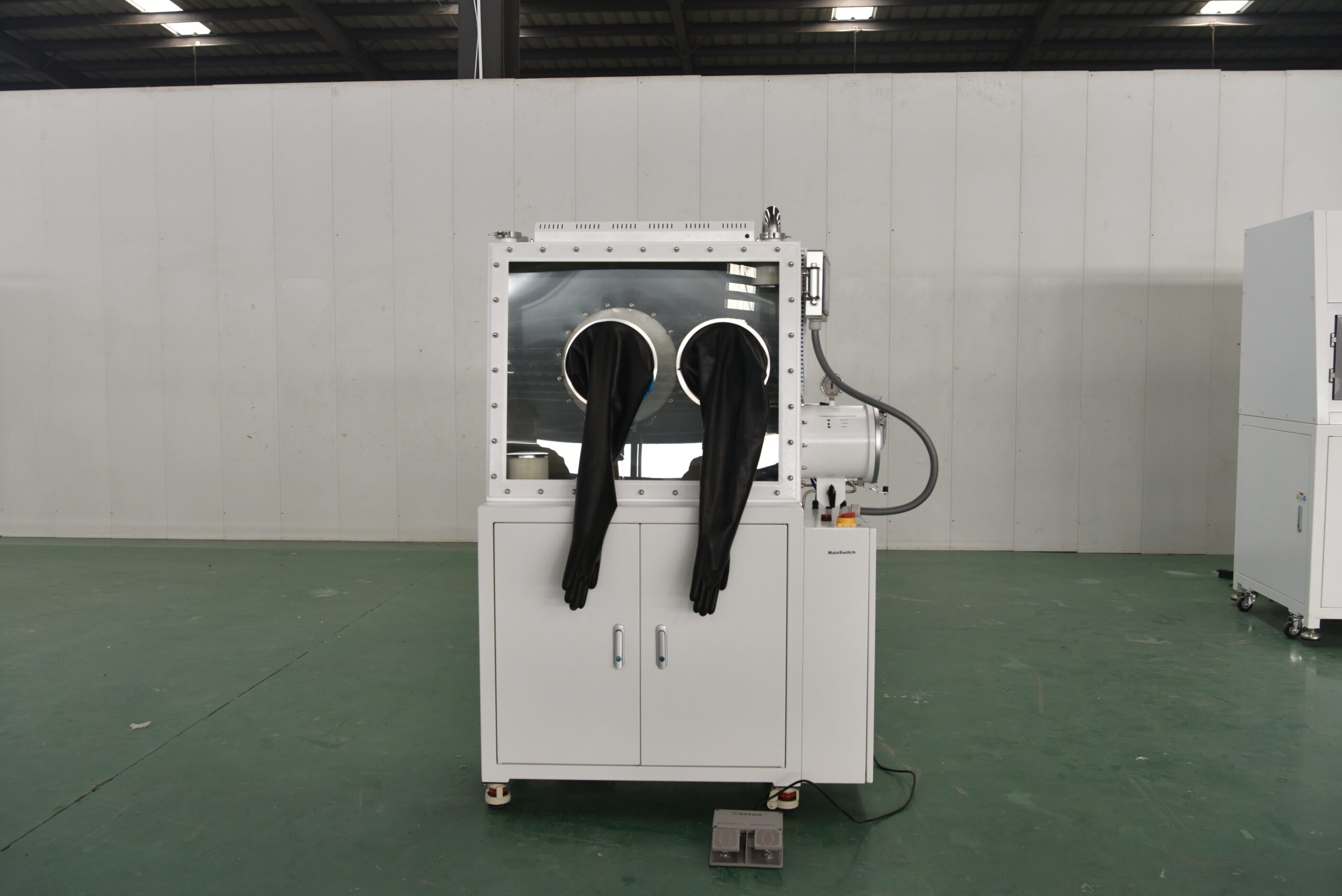
The glove box is a core piece of equipment in any laboratory. Once it malfunctions, at best it delays experiments; at worst, it can ruin entire batches of samples. Over time, various issues are bound to arise. Rather than frantically searching through manuals or calling for service every time something goes wrong, it’s better to master a set of quick self-diagnosis methods. Many faults are actually not complicated and can be resolved in just a few minutes. This article will walk you through the most common glove box fault symptoms, their causes, and quick solutions.
1. Moisture and Oxygen Levels Won’t Drop
This is the most frequently encountered issue—chamber moisture or oxygen levels remain persistently high and won’t drop to the setpoint. When this happens, don’t rush to regenerate the purifier column. Instead, follow this troubleshooting sequence: sensor → purifier column → leakage → operation → gas source. This approach often helps you pinpoint the problem quickly.
Possible causes and solutions:
- Sensor malfunction: Sensor aging, contamination, or calibration drift can cause false readings. Observe the trend—if the value stays stable at an elevated level with little fluctuation, sensor drift is likely. Try exposing the sensor to ambient air and see if the reading rises quickly to normal air levels, 21% for oxygen and varying for moisture depending on humidity. If the rise is slow or the reading is off, the sensor may need cleaning or replacement.
- Purifier column saturation: This is the most common cause. The purifier column loses its adsorption capacity after reaching saturation. Check your equipment usage records. Under normal use, a standard purifier column typically has a regeneration cycle of 1 to 3 years. If that period has been exceeded, saturation is highly likely. For single-column systems, you’ll need to shut down for regeneration; for dual-column systems, switch to the other column and continue operating. Keep in mind that high organic solvent levels inside the chamber can poison the purification material, making regeneration ineffective and requiring material replacement.
- Chamber leakage: External air infiltration is another major cause. Close all valves, stop circulation, and observe chamber pressure changes. If the pressure drops noticeably—for example, more than 1 mbar per minute—there is a leak. Common leak points include damaged gloves, aged transfer chamber seals, aged viewing window seals, and loose valve connections. Use a leak detector or apply soapy water to suspicious areas. If the transfer chamber door is not sealing properly, check whether the seal ring is aged or whether foreign matter is stuck on the door.
- Operational issues: Insufficient transfer chamber pump-purge cycles, inadequately dried samples, undetected glove damage, and frequent opening of the main chamber door can all introduce moisture and oxygen. Standardize transfer chamber procedures—when outside air is humid, perform at least 3 pump-purge cycles.
- Insufficient gas purity: Impure inert gas, such as nitrogen or argon, used for replenishment can also prevent moisture and oxygen levels from dropping. Check cylinder purity—high-purity inert gas typically requires moisture and oxygen content below 3 ppm. Regularly check cylinder pressure to avoid using gas with high impurities from the bottom of the cylinder.
Quick action tip: During commissioning, avoid placing too many samples in the chamber. If samples must be placed inside, dry them first. Check whether regeneration is functioning properly, with special attention to the vacuum hold step during purifier regeneration—the vacuum hold should last more than 2 hours.
2. Circulation Won’t Start or Stops Automatically
Symptom: No response when pressing the circulation button, or circulation stops automatically after running for a while.
Possible causes and solutions:
- Insufficient working gas pressure: Check whether the gas cylinder is open and whether the inlet pressure reaches 0.4 to 0.6 MPa. If the regulator outlet pressure is too low, the angle valve will not open.
- Abnormal chamber pressure: Both excessively high and excessively low chamber pressure will cause circulation to stop automatically. High pressure may be due to continuous gas replenishment; low pressure may be due to an unsealed transfer chamber or leaks.
- Pressure sensor failure: Abnormal sensor readings can cause system misjudgment—inspect or replace the sensor.
- Blower or inverter issues: Voltage instability may trigger inverter protection. Wait for stable voltage, then restart the system after a 1-minute shutdown. After pressing circulation, check whether both indicator lights on the relay are illuminated.
3. Glove Box Continuously Replenishes or Continuously Evacuates
Symptom: Chamber pressure continuously rises, indicating continuous replenishment, or continuously drops, indicating continuous evacuation, with noticeably increased gas consumption.
Possible causes and solutions:
- Transfer chamber door not fully closed: This is the most common cause. Check whether both large and small chamber doors are completely closed.
- Foot pedal pressed down: If the foot pedal switch is pressed by an object, it will continuously trigger replenishment or evacuation signals.
- Solenoid valve stuck: The replenishment or evacuation solenoid valve is stuck by debris and cannot close properly—clean or replace the solenoid valve.
- Seal issues: The equipment itself may have sealing problems—perform a pressure-hold leak test to locate leakage points.
4. Oxygen Level Slowly Rises During Circulation
Symptom: Circulation is running normally, but the oxygen reading rises slowly and continuously.
Possible causes and solutions:
This usually indicates a micro-leak between the chamber and the blower inlet. Use a segmented pressure-hold method to check the following areas:
- Whether the bellows are leaking
- Whether connections are loose
- Whether the purifier column or solvent column is leaking
- Whether gloves are damaged
5. Regeneration Button Does Not Respond
Symptom: No response when pressing the regeneration button; the regeneration program won’t start.
Possible causes and solutions:
- A password is required to operate the regeneration function.
- The vacuum pump is not turned on—it must be started before regeneration.
- The purifier column is currently in circulation mode—regeneration and circulation cannot occur simultaneously on the same column. For dual-column systems, switch to the other column first.
6. Buttons or Screen Unresponsive
Symptom: No response from touchscreen or button operations.
Possible causes and solutions:
- Check whether the glove box pressure is normal—abnormal pressure may trigger system protection mode.
- Check whether the PLC communication cable is loose.
- Check whether the common terminal connections, such as 24M, M, and COM, are loose.
- For unresponsive vacuum pump buttons, also check whether the switch on the vacuum pump body is in the “1 ON” position and whether the vacuum pump circuit breaker has tripped.
7. Sudden Increase in Gas Consumption
Symptom: Working gas consumption rate increases noticeably, and gas cylinders need replacement more frequently.
Possible causes and solutions:
- Piping leakage: Leaks in the piping from the gas source to the equipment—check the cylinder outlet and the valve block gas inlet connections.
- High-vacuum gate valve leakage: The gate valve itself may be leaking gas, or its pressure tube may be leaking.
8. Blower Noise or Tripping
Symptom: Unusual noise from the blower during operation, or sudden shutdown and tripping.
Possible causes and solutions:
- Bearing lacks lubrication: A professional needs to disassemble the blower for oiling and maintenance.
- Excessive load: Check whether the solvent filtration system butterfly valve is opened correctly and whether the gate valve feedback position is correct.
- Inverter protection: Caused by voltage instability—restart the equipment after voltage stabilizes.
In summary, most glove box faults are related to three systems: the gas circuit, seals, and the purifier column. When issues arise, first observe the symptoms, narrow down the scope, and then follow the steps in this article to troubleshoot. Most faults can be quickly identified. If none of the above methods resolve the issue, contact the manufacturer’s technical support. Regular maintenance—such as leak checks, seal ring replacement, and recording moisture and oxygen trends—can also effectively reduce the frequency of faults.
Related Reading:
Precautions for Long-Term Shutdown and Storage of Glove Boxes
Complete List of Common Glove Box Accessories: Gloves, Transfer Chambers, Flanges & Filter Elements