
Introduction: Why Is Packaging “Fleeing” from Air?
As semiconductor process nodes approach their physical limits, advanced packaging has become a key enabler for extending “Moore’s Law.” From 2.5D/3D TSV to Chiplet technologies, packaging requirements for environmental control have undergone a qualitative shift.
In conventional thinking, packaging simply means putting a “jacket” around the chip. However, as chip integration density increases and line widths narrow, moisture and oxygen have become the number-one enemies of yield and reliability. A tiny speck of dust, an invisible oxide layer, or even a trace amount of moisture absorbed from the air can cause “popcorn效应” (popcorn phenomenon) during reflow soldering or complete device failure due to electrochemical corrosion.
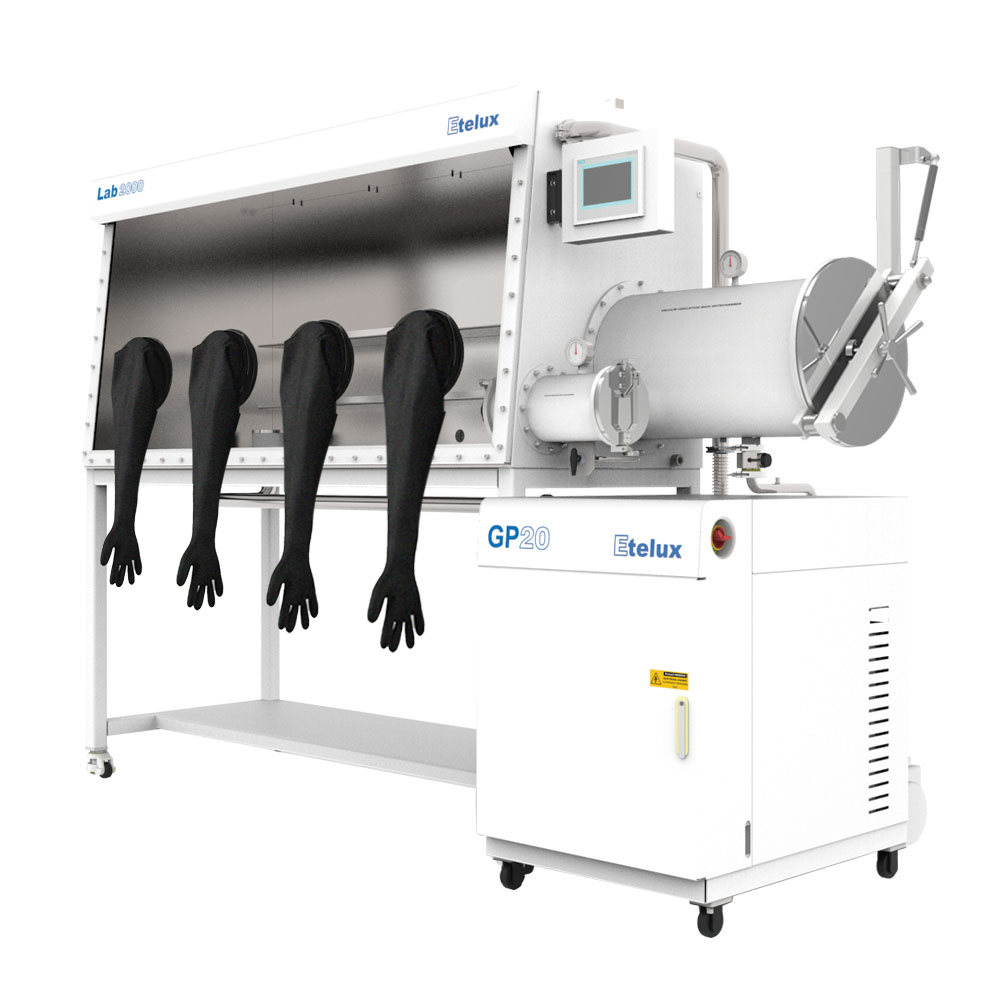
An oxygen-free glovebox, as an extreme localized inert gas environment control device, has evolved from a simple laboratory tool into a core process module on semiconductor packaging production lines. This article delves into how an anhydrous and anaerobic environment can revolutionize packaging processes and provides a complete set of practical application solutions.
01. Pain Points in Chip Packaging: How Do Water and Oxygen Destroy Devices?
Before discussing solutions, we must precisely identify the pain points. The environmental challenges in packaging fall mainly into three dimensions:
1. Interfacial Delamination and the “Popcorn” Effect
The epoxy molding compound (EMC) used in packaging is highly hygroscopic. When chips are exposed to humid air before packaging, moisture penetrates along the lead frame or substrate. During subsequent reflow soldering (typically around 260°C), the absorbed moisture instantly vaporizes. The resulting vapor pressure causes internal interfacial delamination; in severe cases, the molding body cracks open, leading to total scrap.
2. Electrochemical Corrosion and Metal Bonding Failure
For copper wire bonding or exposed aluminum pads, environmental moisture and ionic contaminants form an electrolyte. Under an electric field, metal interconnects corrode, leading to open circuits or increased contact resistance. Especially in MEMS devices and RF components, corrosion at the nanogram level can alter the device’s resonant frequency.
3. Degradation of Sensitive Materials
In optoelectronic packaging (e.g., optical modules, Micro-OLEDs), the optical coatings or quantum dot materials on the chip surface are extremely sensitive to oxygen. Trace amounts of oxygen can quench their luminous efficiency, drastically shortening device lifetime.
Data Alert: Studies show that during packaging, for devices with higher MSL (Moisture Sensitivity Level) ratings, the failure rate increases exponentially if humidity is not properly controlled.
02. The Solution: Core Technical Configuration of Oxygen-Free Gloveboxes in Packaging
Addressing the pain points above, modern industrial-grade oxygen-free gloveboxes are no longer just “boxes.” They are micro-environment control systems integrating purification, dust removal, baking, and detection.
2.1 Ultra-Low Water/Oxygen Levels (<1 ppm) – The Core Threshold
For high-end processes such as IGBT power modules and CSP (chip-scale packaging), industrial gloveboxes must be capable of stably maintaining water and oxygen levels below 1 ppm around the clock. This relies on a dual-column recirculation purification system: while one column is operating, the other undergoes regeneration (heating to desorb impurities), enabling seamless 24/7 switching and uninterrupted production.
2.2 Integration of High-Precision Vacuum Ovens – Removing the “Soul of Moisture”
Many packaging failures are not caused by humidity during operation, but by moisture inherent in the materials themselves.
Solution: Integrate a vacuum oven directly with the glovebox.
Function: Before packaging/bonding, vacuum bake the chips, packages, and lids (e.g., at 120°C–250°C) to remove deeply absorbed water molecules via the vacuum pump. Only by degassing inside the glovebox can long-term internal vacuum or hermeticity be assured.
2.3 Inline Dust Removal and Cleanliness Management
Particle contamination is another major enemy of yield. High-end gloveboxes come standard with HEPA/ULPA filters, creating vertical laminar flow inside the box to achieve Class 100 or even Class 10 cleanliness levels. Combined with electrostatic discharge (ESD) protection (antistatic PC windows, grounding ports), these features prevent ESD damage to sensitive chips.
2.4 Seamless Integration of Parallel Seam Sealers and Automation
Manual handling is the single biggest source of contamination and variability.
Solution: Open ports at the back of the glovebox to integrate an automated parallel seam sealer or laser welder.
Advantage: Robotic arms automatically pick and place lids inside the glovebox, performing sealing in an environment below 1 ppm. This approach is not only faster but also contains welding spatter within the box, protecting operators and eliminating weld oxidation.
03. Practical Scenarios: Application Mapping for Different Packaging Processes
Different packaging formats have vastly different requirements for glovebox configurations. Here are two typical application scenarios:
| Application Scenario | Core Pain Points | Recommended Glovebox Configuration | Expected Benefits |
|---|---|---|---|
| Automotive IGBT/Power Module Packaging | Die-to-substrate solder oxidation, unstable wire bond loops | High-purity nitrogen atmosphere (O2 < 10 ppm), integrated vacuum reflow oven | Improved solder wetting, lower thermal resistance, 30% better heat dissipation |
| Optical Module/Hermetic Device Packaging | Optical attenuation due to internal moisture/oxygen, arcing | Ultra-high-purity environment (H2O/O2 < 1 ppm), integrated parallel seam sealer | Hermeticity verified by helium leak test, 10+ year industrial lifetime |
| MEMS Sensor Packaging | Microstructure stiction, particle sensitivity | HEPA laminar flow clean system, vibration-damping table design | Improved sensor response accuracy, reduced zero drift |
04. Operating Procedures and Common Misconceptions
Purchasing the equipment is only the first step. Proper operating SOPs determine the ultimate effectiveness of the system.
Misconception 1: Neglecting Airlock Chamber Procedures
Many operators, in the interest of speed, fail to perform sufficient pump-down / purge cycles (three or more cycles are recommended) when transferring materials in and out. This allows a significant amount of air to enter the main chamber, increasing the load on the purification columns and shortening their regeneration intervals.
Misconception 2: Controlling Only Water, Ignoring Solvents
If silver pastes, fluxes, or certain cleaning agents are used in packaging, their organic vapors will contaminate the catalyst (e.g., copper getter material), causing “poisoning” of the purification columns. Solution: A solvent adsorption system or dedicated solvent filter must be configured.
05. Summary
Semiconductor chip packaging is entering a new era of system-level integration. In this era, environmental purity equals process precision.
The oxygen-free glovebox is more than just a tool for isolating air; it is a bridge connecting the pristine internal world of the chip with the complex external environment. By creating a “ultra-low oxygen, ultra-low moisture, high cleanliness” micro-environment, the oxygen-free glovebox effectively addresses delamination, corrosion, and degradation issues in packaging. It has become an essential infrastructure for improving the yield of 2.5D/3D stacked packaging and wafer-level packaging.
If you are looking for a packaging solution that meets automotive-grade standards, or if you want to smoothly transfer advanced packaging processes from the lab to mass production, start by evaluating your environmental water and oxygen loading.