
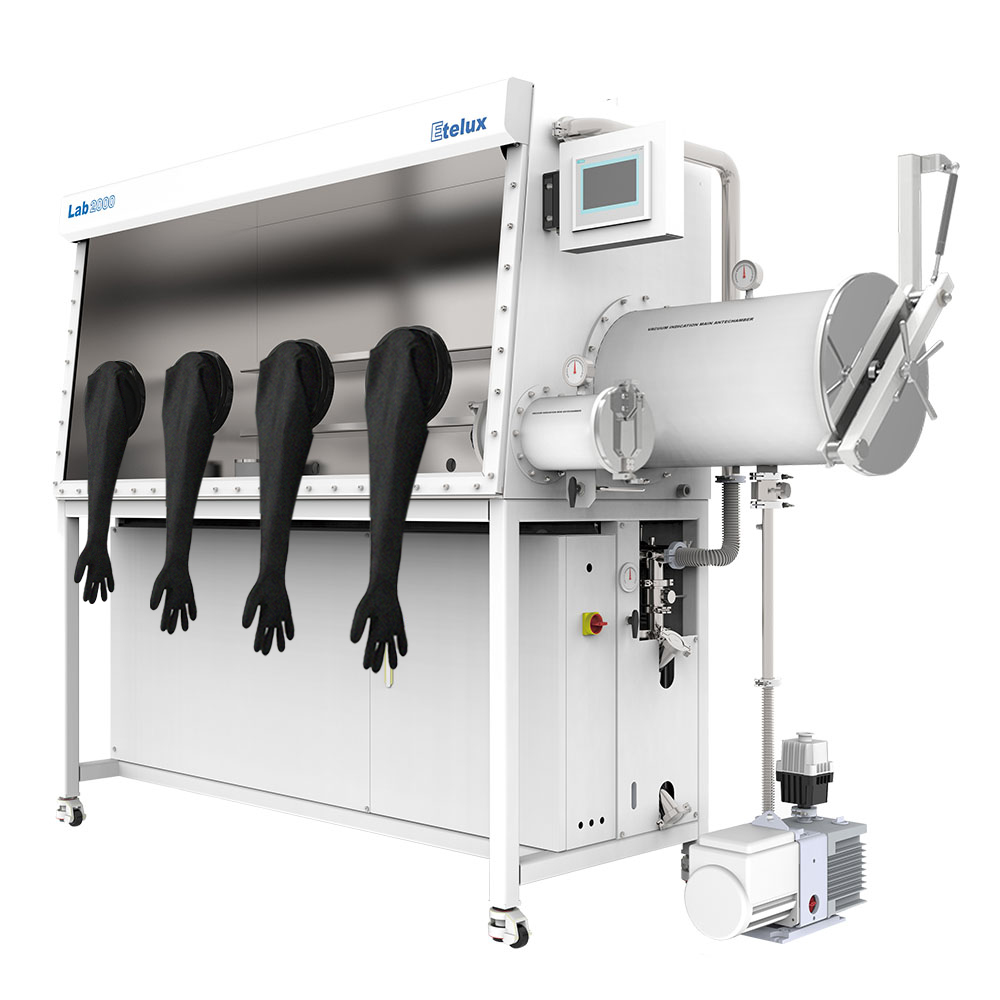
In cutting-edge fields such as lithium batteries, perovskite solar cells, MOF synthesis, and precision weighing, gloveboxes have become standard equipment. But traditional gloveboxes solve only one problem—isolating water and oxygen. They fall short when it comes to temperature fluctuations, humidity changes, and dust contamination inside the chamber.
The constant temperature and humidity glovebox upgrades “atmosphere protection” to “full environmental control.” This article breaks down its core functional advantages to help you determine whether this equipment suits your applications.
1. What Pain Points Does It Solve?
| Shortcomings of Traditional Gloveboxes | Solutions from Constant Temp & Humidity Gloveboxes |
|---|---|
| Internal temperature fluctuates with room temperature—hot in summer, cold in winter | Active temperature control, accurate to ±0.5°C |
| Humidity control relies on inert gas purging—crude and gas-consuming | Independent humidity control system, fluctuation ±1~3% RH |
| Dust and particles generated during operation are not filtered | HEPA / Class 100 cleanroom circulation filtration |
| Heat sources such as hot plates and evaporation sources cause localized overheating | Forced convection airflow design for uniform temperature field |
| Equipment vibration transfers to the chamber, affecting precision weighing and testing | Vibration isolation design with compressor separated from chamber |
One sentence captures the core difference: traditional gloveboxes offer “passive defense,” while constant temperature and humidity gloveboxes provide “active regulation.”
2. Four Core Functional Advantages
Advantage 1: Precision Temperature Control—Freeing Experiments from “Weather Dependence”
The temperature inside a traditional glovebox is simply the lab’s ambient temperature. At 30°C in summer and 15°C in winter, temperature-sensitive processes such as solvent evaporation rates, thin-film crystallization kinetics, and adhesive curing will see significant batch-to-batch inconsistencies.
Constant temperature and humidity gloveboxes integrate air conditioning modules or thermoelectric temperature control systems to achieve:
- Temperature range: 5~70°C, with some models reaching lower limits
- Temperature fluctuation: ±0.1~0.5°C
- Temperature uniformity: ≤1~2°C across the entire chamber space
High-end models use specialized airflow designs such as top supply and bottom return to ensure highly uniform temperature distribution in large chambers, preventing localized hot spots from affecting processes.
Advantage 2: Precise Humidity Control—An Upgrade from “Dehumidification” to “Humidity Regulation”
Traditional gloveboxes rely on inert gas purging or chemical adsorption by purification columns for dehumidification. They can only achieve “as dry as possible,” typically below 1 ppm, but cannot precisely set a specific humidity level.
Constant temperature and humidity gloveboxes are equipped with independent humidification and dehumidification systems:
- Humidity control range: 10%~95% RH, with some low-humidity models requiring auxiliary dry gas
- Humidity fluctuation: ±1~3% RH
This capability is critical for precision weighing, where filter membranes must be conditioned for 24 hours under constant temperature and humidity per standard HJ836-2017, as well as for powder processing to prevent moisture absorption and caking, and for electrostatic-sensitive device testing.
Advantage 3: Clean Circulation—Installing an “Air Purifier” Inside the Chamber
During operation, particles generated by glove friction, sample powders, and material debris contaminate the chamber environment. Traditional gloveboxes either ignore this or rely on simple inlet and exhaust vents.
Constant temperature and humidity gloveboxes integrate HEPA filters with ≥99.97% efficiency for 0.3 μm particles, or Class 100 cleanroom modules meeting ISO Class 5 standards, using fan filter units for continuous gas circulation and filtration.
For processes highly sensitive to particles—such as solar cell fabrication, LED production, and thin-film device manufacturing—this function effectively reduces pinholes, short circuits, and other defects, directly improving product yield.
Advantage 4: System Integration and Dual Circulation—Value Beyond a Single Device
Industry-leading constant temperature and humidity gloveboxes adopt a dual circulation design:
- Internal circulation: Chamber gas passes through temperature control modules, HEPA filtration, and fans to maintain stable internal conditions
- External circulation: Connects to multi-stage purified gas sources including air compressors, filters, freeze dryers, and moisture adsorbers to continuously supply clean, dry air while exhausting waste gas
This design integrates three functions—cleanroom cleanliness, constant temperature and humidity chamber control, and glovebox isolation—into a single device. It compresses the environmental control capabilities that would otherwise require a full cleanroom suite into one compact unit. For research teams and pilot lines with limited budgets but stringent requirements, this represents exceptional value for money.
3. Application Scenarios Overview
| Scenario | Core Requirements |
|---|---|
| Precision weighing such as filter membranes and reference standards | Stable temperature and humidity, vibration isolation, compliant with HJ836-2017 |
| Powder material processing like milling, mixing, and pelletizing | Moisture prevention, anti-caking, oxidation avoidance |
| Photovoltaic thin-film preparation such as perovskite and OLED | Particle-free environment, temperature affects film quality |
| Electronic device testing and aging | Simulated specific temperature and humidity conditions, ESD protection |
| Pharmaceutical and biological sample handling | Constant temperature and humidity, traceability records, access control |
4. Selection Recommendations
When purchasing a constant temperature and humidity glovebox, pay special attention to the following specifications:
- Temperature and humidity control accuracy: Choose based on your process requirements. Typical laboratory applications need ±0.5°C / ±3% RH; high-precision research may require ±0.1°C / ±1% RH.
- Temperature uniformity: Essential for large chambers of two workstations or more—≤2°C is a reasonable benchmark.
- Cleanliness level: Determine whether HEPA or Class 100 cleanroom capability is needed. General powder handling may not require it; thin-film device fabrication does.
- Vibration isolation design: If placing a 0.01 mg precision balance inside, confirm that the manufacturer provides dedicated compressor isolation and anti-vibration measures.
- Airflow architecture: Top-supply and bottom-return or vertical laminar flow designs ensure temperature and humidity uniformity while preventing direct airflow on operators.
Summary
The constant temperature and humidity glovebox essentially brings cleanroom-level environmental control capabilities into a single glovebox. It does more than isolate water and oxygen—it actively regulates temperature, humidity, and cleanliness, freeing experiments and production from dependence on the ambient environment. This enables true end-to-end, round-the-clock, repeatable precision operations.
There is no single “best” equipment choice—only the one that fits your needs. Clarify your process’s actual requirements for temperature, humidity, and cleanliness, then select the configuration that matches. That way, this equipment becomes the “environmental foundation” of your laboratory rather than a cost burden.
Original content by gloveboxes.net. Reproduction requires authorization.
If you have specific questions about selecting or using a constant temperature and humidity glovebox, feel free to leave a comment or contact us directly.
Related Reading:
Complete List of Common Glove Box Accessories: Gloves, Transfer Chambers, Flanges & Filter Elements
Glove Box Selection Guide for Lithium Battery Laboratories