
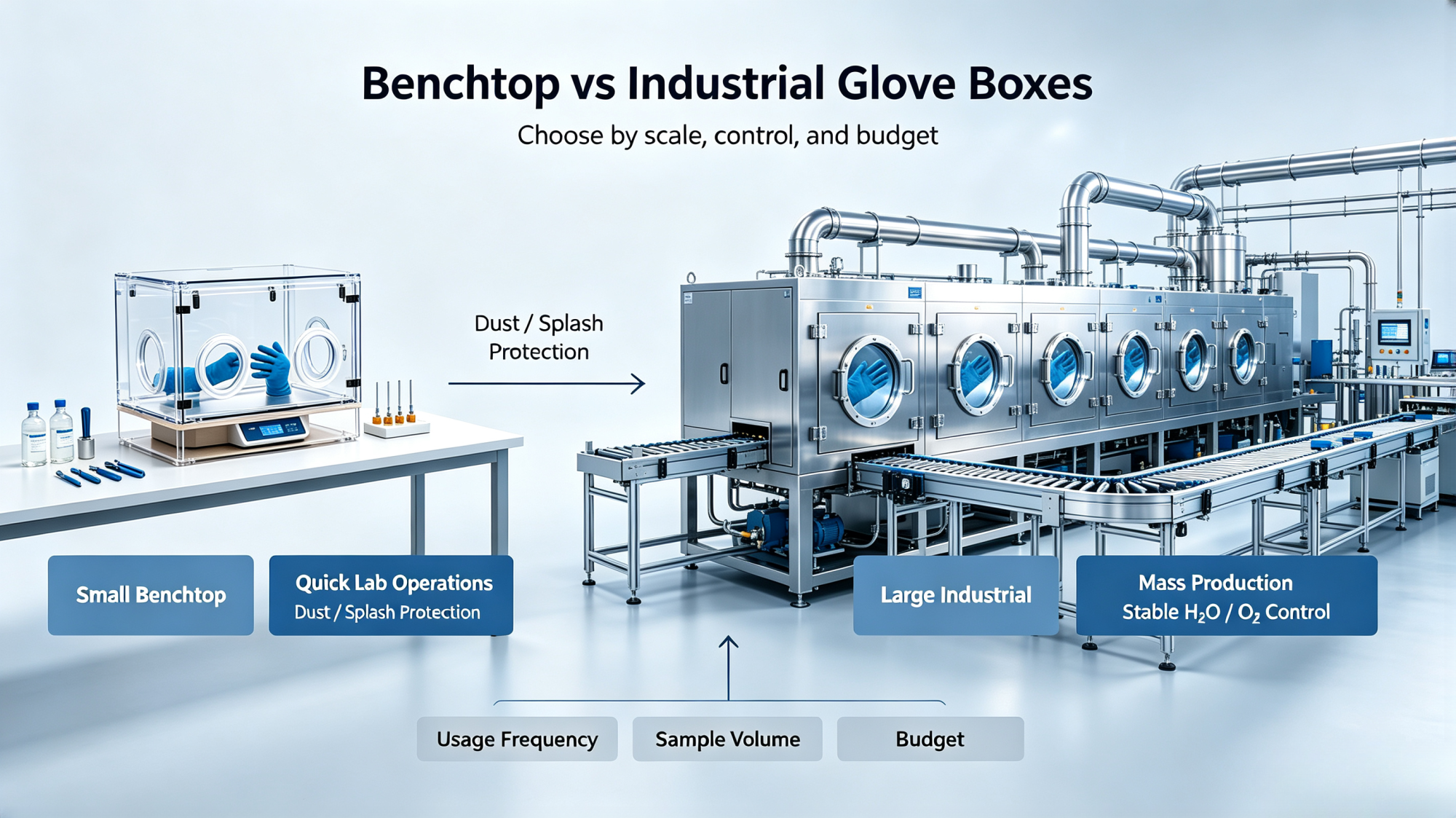
In materials research and industrial production, glove boxes are essential equipment for providing inert gas environments. Faced with small benchtop models and large industrial units, how do you decide? This article breaks down the core differences to help you make a quick judgment.
1. Core Difference: Different Design Goals
| Small Benchtop Glove Box | Large Industrial Glove Box | |
|---|---|---|
| Positioning | Flexible and convenient, ideal for quick lab operations | Stable and efficient, ideal for mass production and complex integration |
| Size | 50-150cm long, sits on a lab bench | Several meters long, floor-standing, requires dedicated space |
| Material | Acrylic (transparent) or stainless steel | 3mm thick 304 stainless steel, welded seal |
| Water/Oxygen Control | Basic models only isolate dust; high-end models can reach ≤1ppm | Standard purification system, long-term stable ≤1ppm |
| Workstations | Single operator | Dual to twelve stations, supports collaborative work |
| Weight | Lightweight, some models only 10kg | Can reach 2500kg |
2. Who Is Each Suitable For?
Small Benchtop Glove Box is suitable for:
- University teaching labs
- Small-scale sample processing (e.g., lithium battery electrode preparation)
- Temporary or mobile experimental needs
- Scenarios requiring only dust and splash protection
Large Industrial Glove Box is suitable for:
- Lithium battery production lines
- OLED/semiconductor manufacturing
- Multi-station collaborative operations
- Large equipment system integration
3. Cost Comparison
| Small Benchtop Glove Box | Large Industrial Glove Box | |
|---|---|---|
| Purchase Cost | Thousands to tens of thousands RMB | Hundreds of thousands to over a million RMB |
| Operating Cost | Purge-type consumes large amounts of gas | Circulation purification, more cost-effective for long-term use |
| Maintenance | Simple, but acrylic has gas permeability issues | Purification columns automatically regenerate, well-established procedures |
4. Three-Step Decision Guide
① Do you only need dust/splash protection?
→ Choose an acrylic benchtop glove box — lowest cost.
② Do you need to handle oxygen/moisture-sensitive materials?
→ Occasional use, small samples → Small stainless steel vacuum glove box
→ Long-term, daily use → Must have a circulation purification system
③ Do you have the space and budget for a large unit?
→ Limited lab space, tight budget → Small purification glove box
→ Production line needs, multi-operator → Large industrial glove box
Summary
| Your Situation | Recommendation |
|---|---|
| Teaching / small samples / temporary use | Small benchtop glove box |
| Long-term stable water/oxygen control | Small purification glove box |
| Mass production / multi-station | Large industrial glove box |
There is no absolute “better” — only what suits you best. Base your choice on usage frequency, sample volume, and budget to avoid common mistakes.
For tailored selection advice, feel free to contact our technical team.
Related Reading:
Industrial Glove Boxes: The Water & Oxygen-Free Precision Operation Platform for R&D & Manufacturing
Difference Between Single-Side and Double-Side Glove Box
What Is a Glove Box & How Does It Work