
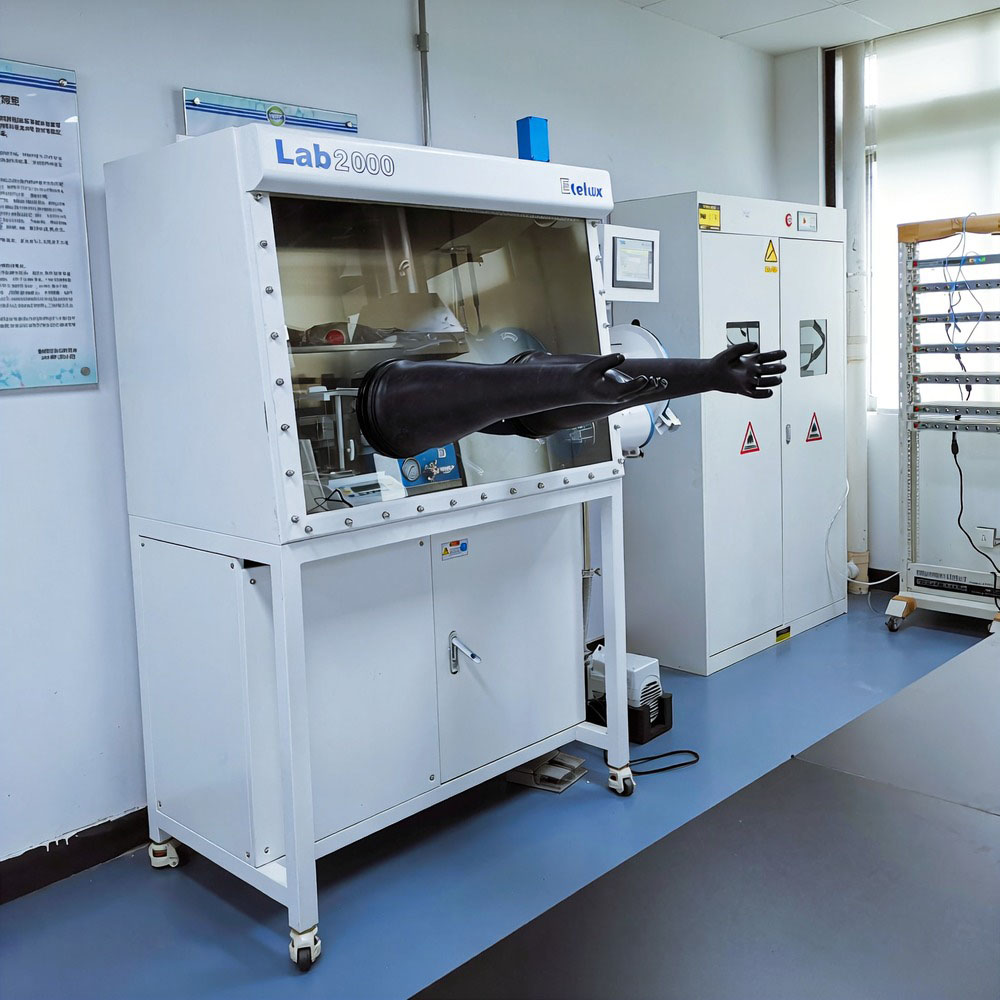
For research institutions and universities, gloveboxes have long ceased to be “optional” equipment. Whether it’s lithium battery material synthesis, MOF/perovskite preparation, or OLED device encapsulation, any experiment involving moisture- and oxygen-sensitive samples relies on a reliable glovebox as the “bottom-line guarantee” for success. Underspecify the configuration, and water/oxygen levels won’t stay down, causing experimental data to drift; choose an impractical layout, and daily maintenance costs may actually exceed the equipment itself.
Today’s post draws on recent public procurement cases and tender specifications from domestic universities over the past two years to help clarify the thought process behind standard glovebox configurations for research labs. The core logic is straightforward: first determine the material, then the number of workstations, and finally focus on core components and expansion features.
1. Chamber Material and Specifications: Don’t Cut Corners on the Basics
For research applications, 304 stainless steel is the overwhelming mainstream choice. The typical thickness requirement is 3mm, with adequate surface treatment on both sides—brushed finish on the interior and anti-corrosion spray coating on the exterior. Acrylic materials, while cheaper, have higher gas permeability and cannot maintain ultralow moisture/oxygen environments over the long term; they are better suited for instructional demonstration scenarios.
In terms of workstations, the standard configuration is either a single workstation (approximately 1200–1900mm in length) or a dual workstation (approximately 1800–2400mm) . For individual researchers, a single workstation is sufficient; however, when shared by a team, housing multiple pieces of equipment inside the box, or requiring collaborative operations, a dual workstation offers much greater flexibility. The custom glovebox purchased by Peking University’s School of Physics, for instance, reached 1900mm in length and simultaneously integrated a thermal evaporation coater.
A special note here: bigger is not always better when it comes to chamber size. Larger volumes proportionally increase gas consumption and the burden on purification columns, which in turn raises routine maintenance costs.
2. Core Specifications: Water/Oxygen Levels and Leak Rate Are Hard Thresholds
Water and oxygen levels below 1 ppm are the standard for research-grade gloveboxes. The JMS-1X glovebox at Qingdao University’s Materials Science Experimental Center, for example, consistently measures <0.1 ppm for both water and oxygen, while the unit procured by the Institute of Geochemistry at the Chinese Academy of Sciences similarly specifies <1 ppm. The 2024 high/low-temperature glovebox procurement at Hunan University of Technology also explicitly requires water ≤1 ppm and oxygen ≤1 ppm.
Even more critical than water/oxygen readings—yet often overlooked—is the leak rate. Industry standards typically require ≤0.05 vol%/h, but high-quality equipment can achieve below 0.001 vol%/h. A lower leak rate means less gas consumption and longer regeneration cycles for purification columns, directly impacting long-term operating costs. Always request actual leak rate test reports from manufacturers during the selection process.
3. Four Core Components: The Difference Between “Adequate” and “Excellent”
3.1 Purification Columns: Single or Dual?
A single-column purification system uses only one column and requires system shutdown during regeneration. A dual-column system, by contrast, allows one column to operate while the other regenerates—ideal for laboratories requiring continuous operation. If your experiments cannot be interrupted, a dual-column automatic regeneration configuration is strongly recommended.
In terms of purification media, the typical configuration is copper catalyst (for oxygen removal) plus molecular sieve (for water removal) , with fill quantities depending on chamber size. The CAS-procured system, for instance, uses 4.8 kg of copper catalyst and 4.8 kg of molecular sieve per column; Qingdao University’s unit uses larger fill volumes (8 kg oxygen remover and 16 kg water remover) for enhanced purification capacity.
3.2 Sensors: The Wrong Choice Equals “Blind” Operation
Sensors serve as the glovebox’s “eyes,” and their accuracy directly affects control performance. ZrO₂ sensors are the mainstream choice for oxygen analyzers, with a measurement range of 0–1000 ppm—offering longer service life and better resistance to atmospheric exposure than traditional fuel-cell probes. P₂O₅ sensors are commonly used for water analyzers, with a measurement range of 0–500 ppm.
High-quality sensor probes should be regenerative to avoid being scrapped after a single contamination event. For long-term stable operation, imported brand sensors are generally recommended.
3.3 Circulation Blower: Noise and Energy Consumption Affect Daily Experience
The circulation blower drives chamber gas continuously through the purification columns and serves as the “heart” of the purification system. Low-quality blowers may produce operating noise exceeding 60 dB, which can be quite distracting in a lab environment over the long run. High-quality equipment can achieve noise levels ≤45 dB and power consumption ≤50W.
Circulation capacity should generally be ≥90 m³/h, with automatic variable-frequency control to adjust circulation speed based on chamber conditions—improving both stability and energy efficiency.
3.4 Seals and Ports: Details Determine User Experience
Front-view windows should use 8mm tempered safety glass with solid-core O-ring flange seals to guarantee ultralow leak rates. Gloves are typically made of butyl rubber, approximately 0.4mm thick, with 8-inch diameter and 32-inch length as standard dimensions.
Plan spare port quantities in advance. The CAS procurement, for example, reserved three DN 40 KF ports and one 220V power outlet to accommodate future connections to external equipment or system upgrades.
4. Transfer Chambers and Expansion Features
Transfer chamber size is one of the most easily overlooked pain points. Discovering post-purchase that common laboratory vessels won’t fit through the transfer chamber can seriously compromise daily usability. The large transfer chamber should ideally have a diameter ≥360mm and length ≥600mm, while the small transfer chamber should have a diameter ≥150mm and length ≥300mm.
Transfer chamber operation can be automatic (PLC-controlled) or manual. For frequent use, automatic operation is recommended for convenience and consistency; for occasional use, manual is sufficient.
For experiments involving organic solvents, adding an organic solvent adsorber (filled with activated carbon) is highly recommended. Otherwise, solvent vapors will poison the copper catalyst and molecular sieve in the purification columns, drastically shortening their service life.
5. Control System and User Experience
Modern gloveboxes typically feature PLC touchscreen control with self-diagnostics, automatic restart after power failure, and adaptive pressure regulation. The chamber operating pressure is generally adjustable within ±10–15 mbar, with automatic system protection activating when exceeding ±12–16 mbar.
Foot pedals are a frequently overlooked but highly practical accessory—allowing operators to raise or lower chamber pressure with their feet while keeping both hands inside the gloves.
6. Quick Reference Configuration Guide
Basic Research (Lithium Batteries, MOFs, Perovskite Synthesis)
304 stainless steel, single-workstation chamber
Water/oxygen <1 ppm, leak rate ≤0.001 vol%/h
Single-column purification + ZrO₂ oxygen analyzer + P₂O₅ water analyzer
Standard large and small transfer chambers
Continuous Operation / Team-Shared Use
Dual-column automatic regeneration purification system (one column active, one regenerating)
Dual workstation or custom large chamber
Built-in organic solvent adsorber
Variable-frequency circulation blower
Special Process Requirements
Heated transfer chamber (up to 150–200°C)
Custom ports for integration with coaters, spectrometers, or other instruments
In-chamber temperature control system
There is no single “best” configuration—only the one that best fits your needs. Start by clearly defining your experimental type, operational frequency, and sample characteristics, then cross-check each item above—you’ll largely avoid common pitfalls. If you’re still unsure after reading, feel free to share your lab requirements and we can discuss further.