
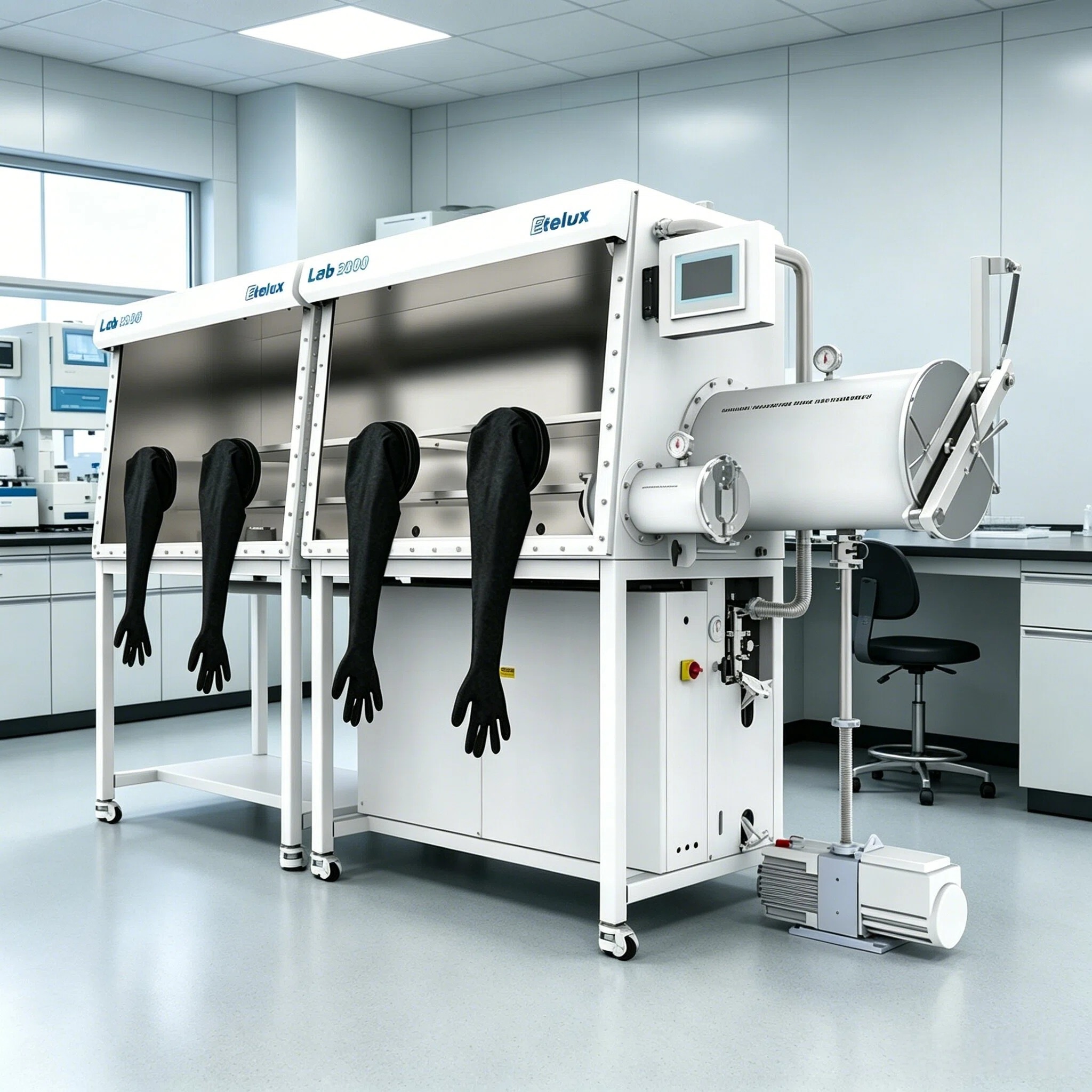
In lithium battery R&D and production, extreme sensitivity to water and oxygen is critical. Moisture causes electrolyte decomposition and generates HF (hydrofluoric acid), which corrodes electrodes. Oxygen destroys the SEI (solid electrolyte interface) film, leading to battery performance degradation or even thermal runaway. Therefore, the choice of glove box directly determines experimental success and safety.
This guide provides a systematic glove box selection framework based on the process requirements of lithium battery manufacturing.
I. Core Requirements for Lithium Battery Glove Boxes
| Parameter | General Requirement | Advanced Requirement (High-Ni/Solid-State/Li-Metal) |
|---|---|---|
| Water content (H₂O) | < 1 ppm | < 0.1 ppm |
| Oxygen content (O₂) | < 1 ppm | < 0.1 ppm |
| Leak rate | < 0.01 vol%/h | < 0.005 vol%/h |
| Particle control | No special requirement | ISO Class 5 or higher (for cleanroom environments) |
High-nickel NCM811 and above, lithium metal anodes, and solid-state electrolytes are extremely sensitive to water and oxygen. Higher-specification glove boxes are mandatory.
II. Box Material: Stainless Steel Is the Only Choice
| Comparison | Stainless Steel | Acrylic |
|---|---|---|
| H₂O/O₂ control | Excellent (can maintain <0.1 ppm long-term) | Poor (cannot achieve low H₂O/O₂) |
| Corrosion resistance (electrolyte/HF) | Good (316L better) | Poor (easily corroded) |
| Vacuum/pressure tolerance | Excellent | Not vacuum-compatible |
| Long-term airtightness | Excellent | Fair |
| Suitability for Li-battery | ✅ Recommended | ❌ Not suitable |
Conclusion: Lithium battery labs must choose stainless steel glove boxes. 316L stainless steel is recommended for better resistance to HF corrosion.
III. Purification System: Water and Oxygen Adsorption & Regeneration
The purification system is the core component that maintains low H₂O/O₂ levels.
Key Components
| Component | Function | Selection Points |
|---|---|---|
| Water adsorber | Adsorbs moisture inside the box | High-efficiency molecular sieve, water capacity > 1000 g |
| Oxygen adsorber | Adsorbs oxygen inside the box | Copper catalyst, oxygen capacity > 100 L |
| Circulation fan | Drives gas through adsorbers | Adjustable flow rate, recommend > 20 m³/h |
| Regeneration system | Restores adsorber activity | Automatic regeneration program, heating + inert gas purge |
Single-Column vs. Dual-Column
| Type | Advantage | Disadvantage | Application |
|---|---|---|---|
| Single-column | Lower cost, smaller footprint | Must stop during regeneration | Intermittent use, small labs |
| Dual-column | Allows 24/7 continuous operation (switch during regeneration) | Higher cost | Continuous production or long-running labs |
👉 Recommendation: Lithium battery labs typically require long-term continuous operation. Dual-column purification systems are recommended.
IV. Water & Oxygen Monitoring System
Without accurate monitoring, you cannot confirm whether the glove box meets specifications.
| Sensor Type | Measurement Range | Accuracy | Recommendation |
|---|---|---|---|
| Dew point meter (moisture) | -100℃ to +20℃ dp | ±2℃ dp | ✅ Preferred |
| Electrolytic moisture sensor | 0–1000 ppm | ±5% FS | Optional |
| Zirconia oxygen sensor | 0–1000 ppm | ±1% FS | ✅ Preferred (high accuracy in low-O₂ range) |
| Electrochemical oxygen sensor | 0–25% | ±2% FS | For ambient O₂ levels |
Selection Points:
- Moisture sensor should measure below -90℃ dew point (corresponding to < 1 ppm H₂O)
- Oxygen sensor should have ppm-level resolution
- Redundant dual sensors are recommended to prevent misjudgment from single-point failure
V. Glove Port Seal – Critical for Leak Prevention
Lithium battery glove boxes require extremely low leak rates, and glove ports are the primary potential leak points.
| Seal Structure | Leak Risk | Recommendation |
|---|---|---|
| Single O-ring + clamp | Medium | Basic |
| Double O-ring + intermediate vacuum | Extremely low | ✅ Highly recommended |
| Welded glove port | Extremely low (but non-replaceable) | Single-use/extreme sealing |
Best Practice: Choose double O-ring glove ports with a vacuum monitoring port. Even if the inner seal fails, the outer seal and vacuum cavity still block water/oxygen ingress.
VI. Transfer Chamber Design
The transfer chamber allows material entry/exit without opening the main box door and causing H₂O/O₂ spikes.
Key Parameters
| Parameter | Recommended Value | Explanation |
|---|---|---|
| Chamber diameter | ≥ 300 mm | Accommodates standard materials |
| Chamber length | ≥ 400 mm | Sufficient placement space |
| Seal material | FKM (fluorocarbon) | Resists electrolyte vapor corrosion |
| Vacuum capability | Down to ≤ 1 mbar | Fast gas exchange |
Round vs. Rectangular Transfer Chamber
| Type | Advantage | Disadvantage |
|---|---|---|
| Round | High pressure resistance, reliable sealing | Lower usable volume |
| Rectangular | Higher space utilization | Lower pressure resistance |
👉 Recommendation: Lithium battery labs commonly use large round transfer chambers (e.g., Ø400×500 mm), balancing pressure resistance and practicality.
Automatic vs. Manual Transfer Chamber
| Type | Operation | Efficiency | Cost |
|---|---|---|---|
| Manual | Manual control of vacuum/purge cycles | Moderate | Low |
| Automatic | One-button start, fully automatic cycles | High | Medium-high |
When transferring materials frequently, an automatic transfer chamber significantly improves efficiency.
VII. Solvent Adsorber (Optional)
Lithium battery experiments commonly use electrolytes containing organic solvents (e.g., DMC, DEC, EC). These solvent vapors:
- Reduce molecular sieve adsorption efficiency
- Corrode seals (especially O-rings)
- Accumulate inside the glove box, affecting experiments
Solution: Configure a solvent adsorption system – an independent activated-carbon loop specifically designed to adsorb organic vapors.
⚠️ If your work involves substantial electrolyte handling, a solvent adsorber is strongly recommended.
VIII. Other Key Configurations
| Feature | Function | Recommendation |
|---|---|---|
| Refrigerator/freezer compartment | Store temperature-sensitive materials (e.g., LiPF₆ electrolyte) | Recommended |
| Dust removal system (HEPA/ULPA) | Control particles, prevent electrode contamination | Essential for high-Ni/solid-state batteries |
| Positive pressure maintenance | Prevent outside air ingress | Essential |
| Touchscreen control system | Centralized display of H₂O, O₂, pressure, regeneration status | Recommended |
| Remote monitoring/alarm | Notify immediately in case of abnormality | Recommended (essential for 24/7 operation) |
| Micro-manipulation ports | Enable in-situ observation with microscope | Optional for R&D labs |
IX. Typical Configuration Levels
Level 1: Basic Lithium Battery Glove Box
- Stainless steel box (304)
- Single-column purification system
- Single O-ring glove ports
- Manual round transfer chamber
- Dew point meter + zirconia oxygen sensor
Applicable for: Coin cells, routine material screening, intermittent experiments
Level 2: Standard (Recommended)
- Stainless steel box (304 or 316L)
- Dual-column purification system (24/7 operation)
- Double O-ring glove ports (with intermediate vacuum)
- Automatic round transfer chamber
- High-precision H₂O/O₂ sensors (-100℃ dew point + ppm-level oxygen)
- Solvent adsorber
Applicable for: Pouch cells, cylindrical cells, routine electrolyte handling
Level 3: High-End (High-Ni/Solid-State/Li-Metal)
- 316L stainless steel box
- Dual-column purification + high-efficiency H₂O/O₂ removal media
- Double O-ring glove ports + vacuum monitoring
- Automatic transfer chamber + large diameter
- Ultra-low leak rate (<0.005 vol%/h)
- HEPA/ULPA dust removal system
- Refrigerator/freezer compartment
- Remote monitoring and alarm system
Applicable for: High-nickel NCM811 and above, lithium metal anodes, solid-state electrolytes, pre-commercial cell R&D
X. Common Selection Mistakes
| ❌ Mistake | ✅ Correct View |
|---|---|
| “Acrylic glove boxes are cheaper and work fine” | Acrylic cannot maintain <1 ppm H₂O/O₂ long-term and is not resistant to electrolyte/HF corrosion |
| “Any purification system will do” | Purification capacity directly determines the lower limits of H₂O/O₂ and maintenance frequency – do not compromise |
| “Leak rate isn’t important” | Even tiny leaks will cause slow H₂O/O₂ rise over long-term operation |
| “Sensors don’t need calibration” | Sensor drift leads to misjudgment – calibrate annually |
| “Glove boxes don’t need maintenance” | Regular seal replacement, adsorber regeneration, and sensor calibration are essential |
XI. Selection Checklist
Use this checklist before purchasing:
- Box material: 304 or 316L? (316L recommended if HF exposure expected)
- Purification system: single-column or dual-column?
- Glove port seal: single O-ring or double O-ring + vacuum?
- Transfer chamber: manual or automatic? Is diameter sufficient?
- H₂O/O₂ sensors: does range cover target values? (dew point < -90℃?)
- Solvent adsorber needed?
- Refrigerator/freezer compartment needed?
- Dust removal system needed?
- For 24/7 operation, is remote monitoring/alarm needed?
- Does the manufacturer provide leak rate test reports and after-sales service?
XII. Summary
Lithium battery applications demand much more from glove boxes than general uses. Key points summarized:
- Material must be stainless steel – 316L recommended for HF exposure
- Dual-column purification preferred – enables 24/7 continuous operation
- Double O-ring + vacuum monitoring for glove ports – seals the largest leak risk
- Sufficient sensor accuracy – dew point meter must reach below -90℃
- Solvent adsorber strongly recommended – protects purification system and seals
- Select configuration by application tier:
- Coin cells → Basic
- Pouch/cylindrical cells → Standard
- High-Ni/solid-state → High-End
When purchasing, look beyond the equipment itself. Pay attention to the manufacturer’s leak rate testing standards, after-sales responsiveness, and industry reputation. The right glove box is the foundation for long-term, stable operation in a lithium battery laboratory.